Saw the latest Indy film. Not so good. Too many old man jokes--in fact, when I first heard there were plans for another Indiana Jones movie (way back during the summer of 2000), there were references to Harrison Ford being in a wheelchair for the film. The writers perceived the public's awareness that perhaps Harrison Ford was getting a bit old and overcompensated with reference after reference to Ford's age. Also, some of the staple ruins and labyrinth scenes seemed like they belonged in the 1985 Goonies, not the 2008 Indiana Jones.
I think my biggest problem with the movie is that I am now 28 years old and not 10--the age when I saw The Last Crusade. As a kid, I loved these films. Just last year Sarah and I watched them again and were pretty disappointed. Some movies--like Flight of the Navigator and Gremlins--are best left stored in childhood memories. I guess my problem with the film is that it came out about 15 years too late.
Sunday, May 25, 2008


Saturday, May 24, 2008
Madonna and Playboy Bunny
For research during seminary I thumbed through many issues of Christianity Today. Often I would get sidetracked by interesting articles. One of those articles was written by Richard J. Mouw, now president of Fuller Seminary. The article tried to understand the unlikely union of two recognizable symbols, the Virgin Mary and the Playboy bunny. What follows is a summary of the article:
Close to forty years ago, Mouw saw coupled upon an automobile the Virgin Mary and the Playboy Bunny. This experience threw Mouw into a "frenzied attempt to absorb it into [his] theology." Perhaps the uniting of these symbols was to provide an epiphany, a window into the "Spirit of the Age." Assuming that something was to be gleaned from this odd pairing, Mouw began interpreting. Maybe this was cause to rethink H. Richard Niebuhr's Christ and Culture paradigm since here was the "Mother of Christ" and the "Pet of Hefner standing in relatively stable confrontation within a single organism, with neither one being quite dominated, or transformed by, or exalted at the expense of, the other." Or perhaps this was emblematic of the evolution of the twentieth-century woman, from the servant Mary to the autonomous Playmate. And, in Hegelian terms, this thesis and antithesis were dueling to beget a synthesis that points "to some middle, even transcendent, way that at once embraces and rises above the conflict." Possibly this was to be interpreted more broadly as a "prophetic-priestly clash," Mother Mary embodying traditional morality and the bunny representing the New Morality.
Having delved into several possible meanings, Mouw concludes that this is "a case where the medium is the message." These meaning-rich emblems are nullified by their substance, that is, "they are fashioned by...the same plastic-and-cellophane culture, a culture whose very plasticity allows for the real possibility that Madonnas and Bunnies are mass-produced in the same factory." Mouw believes that such a culture sucks out the power of the sacred and profane to judge each other. And so it is that images constructed of such material can peacefully get along.
I found this to be a very illuminating--it even has worked its way into one of my dissertation chapters. Mouw's cause for concern has only multiplied since he wrote this in 1970.
Close to forty years ago, Mouw saw coupled upon an automobile the Virgin Mary and the Playboy Bunny. This experience threw Mouw into a "frenzied attempt to absorb it into [his] theology." Perhaps the uniting of these symbols was to provide an epiphany, a window into the "Spirit of the Age." Assuming that something was to be gleaned from this odd pairing, Mouw began interpreting. Maybe this was cause to rethink H. Richard Niebuhr's Christ and Culture paradigm since here was the "Mother of Christ" and the "Pet of Hefner standing in relatively stable confrontation within a single organism, with neither one being quite dominated, or transformed by, or exalted at the expense of, the other." Or perhaps this was emblematic of the evolution of the twentieth-century woman, from the servant Mary to the autonomous Playmate. And, in Hegelian terms, this thesis and antithesis were dueling to beget a synthesis that points "to some middle, even transcendent, way that at once embraces and rises above the conflict." Possibly this was to be interpreted more broadly as a "prophetic-priestly clash," Mother Mary embodying traditional morality and the bunny representing the New Morality.
Having delved into several possible meanings, Mouw concludes that this is "a case where the medium is the message." These meaning-rich emblems are nullified by their substance, that is, "they are fashioned by...the same plastic-and-cellophane culture, a culture whose very plasticity allows for the real possibility that Madonnas and Bunnies are mass-produced in the same factory." Mouw believes that such a culture sucks out the power of the sacred and profane to judge each other. And so it is that images constructed of such material can peacefully get along.
I found this to be a very illuminating--it even has worked its way into one of my dissertation chapters. Mouw's cause for concern has only multiplied since he wrote this in 1970.
American Idol wrap-up
I've posted on Idol before (on the enigmatic use of "Shout to the Lord"). We enjoy the show, particularly this season. The New York Times has a good wrap-up to the season.
Sunday, May 18, 2008
Entitlement and Exclusivity
Today our Sunday school class discussed a problem modern people have with the Gospel: the exclusivity of Jesus. That is, the truth that only through expressed faith in Jesus can one be saved. There are a number of factors that contribute to the difficulty people have with this doctrine. For example, many sociologists have pointed out that when the world we inhabit is filled with a variety of religions, ideologies, and -isms, the plausibility of any one of those religions, ideologies, or -isms being true becomes hard to imagine.
Christians have correctly noted that the question of whether there are multiple ways to God is the wrong one to be asking. Instead, we need to ask why there is one way at all!
But this question, while appropriate, does not seem to carry the force that it should. Why? I think a large part of the reason is the sense of entitlement that runs deep within us. Those of us in America (and other modern, western settings) have unprecedented wealth and resources. Some of the poorest among us live with more comforts and conveniences than a medieval king. Lagging closely behind wealth is a sense of entitlement. Add to this the deluge of ads we receive that pander to our whims and wishes and you can see how plausible the idea of entitlement is.
This sense of entitlement is an assumption. I am guessing that it is not shared by those starving in Africa. We are catechized by the structures, systems, and forms that comprise our contemporary context. In our particular moment, the context happens to catechize in a way that makes belief in the exclusivity of Jesus difficult to maintain. We interact with legions of spiritualities and religions and, we think, surely there is not only one religion that is TRUE. The important thing to bear in mind is that every generation is blind to their own assumptions, prejudices, presuppositions, etc.
That God has provided a way for fellowship with him is astonishing. And he did so at such a great cost. Nothing less than the death of his own son. It is troubling that, amidst our spoiledness, we say, "that's not good enough."
There is a video on this narrated by R.C. Sproul worth watching (HT: Justin Taylor).
Christians have correctly noted that the question of whether there are multiple ways to God is the wrong one to be asking. Instead, we need to ask why there is one way at all!
But this question, while appropriate, does not seem to carry the force that it should. Why? I think a large part of the reason is the sense of entitlement that runs deep within us. Those of us in America (and other modern, western settings) have unprecedented wealth and resources. Some of the poorest among us live with more comforts and conveniences than a medieval king. Lagging closely behind wealth is a sense of entitlement. Add to this the deluge of ads we receive that pander to our whims and wishes and you can see how plausible the idea of entitlement is.
This sense of entitlement is an assumption. I am guessing that it is not shared by those starving in Africa. We are catechized by the structures, systems, and forms that comprise our contemporary context. In our particular moment, the context happens to catechize in a way that makes belief in the exclusivity of Jesus difficult to maintain. We interact with legions of spiritualities and religions and, we think, surely there is not only one religion that is TRUE. The important thing to bear in mind is that every generation is blind to their own assumptions, prejudices, presuppositions, etc.
That God has provided a way for fellowship with him is astonishing. And he did so at such a great cost. Nothing less than the death of his own son. It is troubling that, amidst our spoiledness, we say, "that's not good enough."
There is a video on this narrated by R.C. Sproul worth watching (HT: Justin Taylor).
Thursday, May 15, 2008
Nigel Biggar lecture
Nigel Biggar, Regius Professor of Moral and Pastoral Theology at Oxford, delivered a lecture grappling with how the Christian should engage in public discourse. I found it helpful.
Friday, May 9, 2008
Bourdieu and The Study of Religion
 My PhD research draws heavily upon sociology. Going the sociology route meant delving into a large body of literature largely unfamiliar to me. A good chunk of last year was spent immersing myself in this body of work. David Wells' research on evangelicalism and modern/postmodern life has been my inspiration for pursuing this type of research. Wells' books on the subject have utilized a good amount of sociology and, consequently, have provided an interesting angle on the issue of church and culture.
 Recently, my supervisor recommended that I look at the work of French sociologist, Pierre Bourdieu. For Bourdieu, any society consists of various "fields." Each field contains different types of capital, that is, material and non-material resources that give individuals an edge in life. For example, in the economic field there is a struggle over monetary resources. In academia, individuals might vie for prestige. Religion is a field bound up with its own type of capital: meaning, salvation, etc. For Bourdieu, the struggle for significance is fundamental to understanding social relations. Individuals compete to etch out a place in the field or social arena they inhabit. And individuals become adept at navigating a number of different, yet perhaps overlapping, fields. Shaping an individual's play in the field is habitus, that is, an urge or impulse that directs one's actions. It sounds to me like habitus is somewhat like a worldview, although less systematic and tidy than the way one would traditionally think of a worldview. Habitus is operative at a deeper level of consciousness than a worldview might be.
Bourdieu dabbled in religion but spent the bulk of his work investigating this theory as it applied to culture and art. Sociologists of religion, however, have been applauding its usefulness for the study of religion. And--while I do not agree with some of the presuppositions undergirding Bourdieu's theory--I think it will be a helpful template for understanding some of my research. I have read several journal articles on Bourdieu but have yet to get my hands on any of his books--so my understanding of him is limited to secondary sources; I will take a trip to the library this week to remedy that.
Monday, May 5, 2008
Wheaton and the Fact/Value Divide
I recently posted on the fact/value split that pervades American life (see below). It is a concern for Christians who are called to make Christ Lord of all their life, including their time in the public square. The recent resignation of Kent Gramm amidst his divorce and the media's response to the issue provides an insightful window into the way this split works.
Alan Jacobs, Wheaton professor and one of Gramm's colleagues, has a good discussion of the entire situation in his post for the First Things blog.
Alan Jacobs, Wheaton professor and one of Gramm's colleagues, has a good discussion of the entire situation in his post for the First Things blog.
Saturday, May 3, 2008
Trust Jesus, Not Politics
Americans have too much faith in American politics. And we're not the only ones. Moderns in general tend to place a great amount of hope in the state that governs them. Craig M. Gay has argued this point in the The Way of the Modern World. He says, "While we may lose faith in this or that politician and/or party from time to time, our belief in the potential of the political process tends to be unshakable" (31). The sheer size of modern states along with their technological resources give plausibility to their potential for solving any and every problem.
At the same time, however, there seems to be some skepticism toward government intervention. My job at the elementary school required a class that delved into legislation for the public school system. This lecture suggested that many of the changes, particularly the latest No Child Left Behind Act, have created enormous difficulty for the public schools. And the class as a whole seemed to affirm the frustration over this legislation. Also, consider the grumbles that accompany tax season. If our trust in American politics was consistent, tax season would be a treat, a good and pleasing offering to our omniscient, omnibenevolent, and omnipotent government.
Evangelicals in particular have typically expressed a good amount of faith in American politics, notwithstanding some evangelicals that have recently convened to amend evangelicalism's tight relationship with politics. While we should be good, concerned citizens, we need to remain aware of political limitations. Barack Obama, Hillary Clinton, and John McCain will not save us. They will not provide universal flourishing. If we believe that can be attained by a Democrat or Republican, we have sorely undestimated our problem. The ultimate problem is sin and it has penetrated not just human hearts but all of creation, including human structures and systems, like governments. This requires a massive overhaul, in fact, nothing short of the re-creation of all things. Thanks to Jesus' work and the power of the Holy Spirit, we can experience this project of redemption and even participate in it. This process of building the Kingdom must be our priority. Of course, this includes being politically engaged citizens but it also transcends that.
As the promises of the candidates soar to new heights this summer and fall, beware. They will find it nearly impossible to deliver. Their proposals that sound so neat and tidy will become sloppy in the complexity of real life. The only thing that can overcome the difficulty of sin is the Gospel of Jesus. That is where our ultimate hope must be.
At the same time, however, there seems to be some skepticism toward government intervention. My job at the elementary school required a class that delved into legislation for the public school system. This lecture suggested that many of the changes, particularly the latest No Child Left Behind Act, have created enormous difficulty for the public schools. And the class as a whole seemed to affirm the frustration over this legislation. Also, consider the grumbles that accompany tax season. If our trust in American politics was consistent, tax season would be a treat, a good and pleasing offering to our omniscient, omnibenevolent, and omnipotent government.
Evangelicals in particular have typically expressed a good amount of faith in American politics, notwithstanding some evangelicals that have recently convened to amend evangelicalism's tight relationship with politics. While we should be good, concerned citizens, we need to remain aware of political limitations. Barack Obama, Hillary Clinton, and John McCain will not save us. They will not provide universal flourishing. If we believe that can be attained by a Democrat or Republican, we have sorely undestimated our problem. The ultimate problem is sin and it has penetrated not just human hearts but all of creation, including human structures and systems, like governments. This requires a massive overhaul, in fact, nothing short of the re-creation of all things. Thanks to Jesus' work and the power of the Holy Spirit, we can experience this project of redemption and even participate in it. This process of building the Kingdom must be our priority. Of course, this includes being politically engaged citizens but it also transcends that.
As the promises of the candidates soar to new heights this summer and fall, beware. They will find it nearly impossible to deliver. Their proposals that sound so neat and tidy will become sloppy in the complexity of real life. The only thing that can overcome the difficulty of sin is the Gospel of Jesus. That is where our ultimate hope must be.
Tuesday, April 29, 2008
"The Big Picture Story Bible"
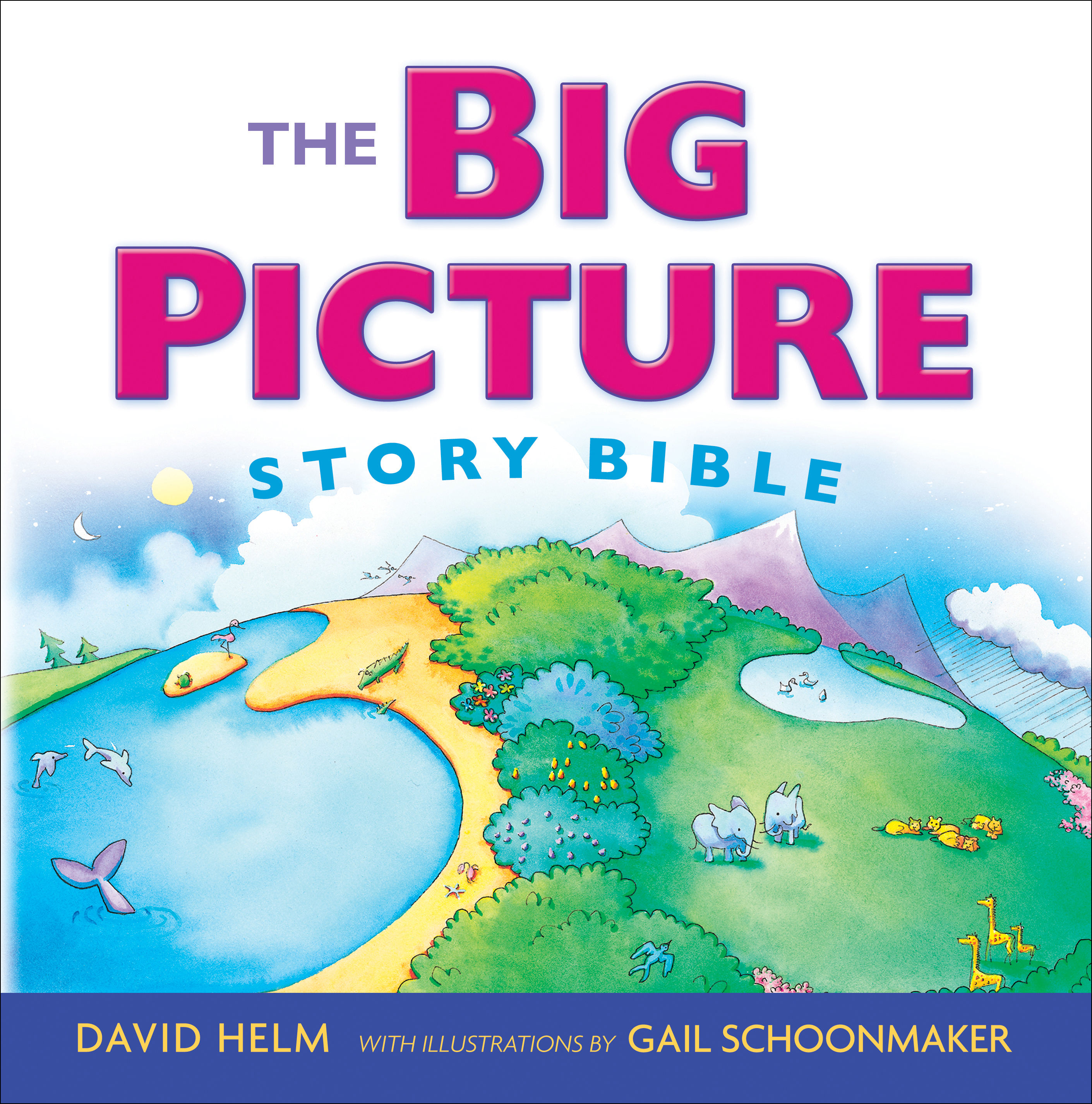
"The Big Picture Story Bible" was one of the gifts we received when Cora was born. While I am not privy to the many children's bibles that exist, I must say that this is an excellent one. It gives a broad sweep of God's plan of redemption. This children's bible properly maintains the centrality of Christ to redemptive history and captures the drama of many of the OT stories by keeping little ears alert to Christ's relationship to these great OT characters. There is even a chapter that explains how Christ fulfilled the promises of the OT. This book brings the bible together in a way that I did not understand until seminary.
Sarah and I are already reading the bible to Cora because, at the suggestion of a former pastor, we do not want Cora to remember a time when we did not read scripture with her. For parents looking for a children's bible, I highly recommend this one. My only quibble is that the illustrator put too many white people in the pictures. I am not sure that the Ancient Middle East had too many redheads running around--although Esau was "red." Otherwise, I really enjoy the illustrator's artwork, especially the sly fox that seems to always make an appearance.
Wednesday, April 23, 2008
More on "Expelled"
I don't want to devote this blog to all things "Expelled," but I ran across the most helpful review yet. Thanks again to Justin Taylor.
Tuesday, April 22, 2008
"Expelled"
 (Note: When I refer to "Darwinists," I am referring to the atheist variety. There are many theists that support Darwinism.)
 Lots of mudslinging and name-calling has accompanied the release of Expelled: No Intelligence Allowed. Having followed some of the reviews, blogs, and message boards, I have heard deafening barks, but little bite.
Many comments suggest that Expelled is trying to sneak faith (or God) into science. Regarding this charge, the narrator, Ben Stein, tactfully nudged the Darwinian interviewees back to their faith commitments, pressuring them until they spewed out beliefs in crystals and aliens "seeding" our planet. The point was clear: All have faith commitments. Whether one believes in God, aliens, or crystals, all are exercising faith. And these scientists are allowing this faith to inform their science. They are not opposed to faith (e.g. crystals and aliens work) but faith of a particular kind.
Another criticism came from a New York Times review of the film, which called the documentary one of the "sleaziest" in a long time. The reviewer states that the film ignores "the vital distinction between social and scientific Darwinism." The reviewer is referring to the film's suggestion that Darwinism had a part to play in legitimating the Holocaust. It seems to me that to make a sharp distinction between scientific and social Darwinism, as this reviewer does, is to undermine scientific Darwinism. If naturalistic, Darwinian evolution is true (and if we are intellectually honest) then its implications should be pushed to every aspect of life, including society. The film is not saying that all Darwinian proponents are bloodthirsty Nazis. It is suggesting that Darwinian science provides a compelling justification for genocide. And Nazi rhetoric was undoubtedly laced with Darwinian ideas. The person that divorces scientific Darwinism from social Darwinism is being inconsistent. They are, in other words, employing the fact/value split (see below). Rather than call the link between the Holocaust and Darwinism unfair, even preposterous, what I'd like to see a cogent critique of genocide from a Darwinian position.
These are just a couple of challenges or charges I have encountered while following the film’s release. Ironically, the vehement criticism over this film gives clout to its main point: a bullying majority refuses to allow other voices to be heard. This majority refuses to even allow debate over Intelligent Design because they are allowing their presuppositions (philosophical materialism) to tape-off the boundaries of what counts as science. This is not science. And I wonder how much this suppression is stymieing the progress of science. Also, the palpable anger over Expelled leads one to wonder whether this issue is really about science, as many Darwinists insist. Instead, it seems this debate is about deeply entrenched faith commitments.
Justin Taylor has pointed out two reviews of the film worth reading, one by Michael Patton and the other by Douglas Groothuis.
Sunday, April 20, 2008
Oklahoma City Bison?
 Sounds like the Seattle Sonics are coming to OKC. Great news for Okies who do not currently have a pro-team, but proved they could support one when the exiled Hornets came to town.
There's been talk about what to name OKC's team. Perhaps the worst suggestion I've heard is the Vipers. My personal favorite is the Oklahoma City Bison. This animal is amazing. Its an American icon emblematic of brute strength and speed. It is also region-appropriate.

Subscribe to:
Posts (Atom)

 Posts
Posts

